The Hemingses of Monticello: An American Family by Gordon-Reed Annette
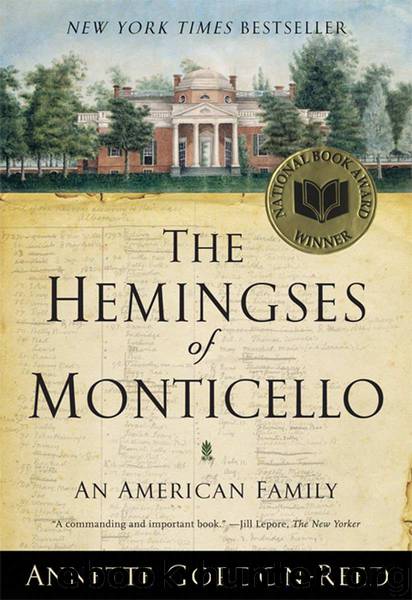
Author:Gordon-Reed, Annette [Gordon-Reed, Annette]
Language: eng
Format: epub
Publisher: W. W. Norton & Company
Published: 2009-09-08T00:00:00+00:00
THE ALMOST FIFTY-FIVE-YEAR-OLD Elizabeth Hemings welcomed home her son and daughter who had been away in a distant place for years. Few Afro-Virginian women in her position ever experienced such a thing: to be able to listen to her children describe a world across an ocean that they had come to know intimately, perhaps bringing gifts and certainly bringing knowledge of a different language and culture from that faraway place. She, and no one else in her time, had the same expectations about maintaining easy contact with absent relatives that exist in the modern world. For all his wealth and power, Jefferson himself could not make a ship carrying a letter travel faster across the ocean than any other man could. Near the end of his stay in France, he sent the only letter he ever wrote to his younger brother, Randolph, while he was abroad, in which he makes clear that he did not even know how many children his brother had.10 He communicated more with his sister and in-laws, with whom he was close, but those contacts, too, were invariably far apart in time. Even within those structural limits on communication, Jefferson at least was part of a social world in which all the immediate members of his family were literate, if some only marginally so. Words on a page connected them to people far beyond the sound of voices, conveying information and providing physical evidence that, within the time of sending and receiving, the correspondent was still present on earth.
Though Elizabeth Hemings lived in a world where oral communication was primarily the order of the day, her sons Robert and James Hemings could easily have written to one another while James and Sally were overseas.11 If brother and sister did send any letters or packages to Monticello from France, no traces of them remain. Their communications, however, would not have been a part of Jefferson’s record of his incoming and outgoing correspondence, so one cannot look to his papers to decide the matter. Those items would have gone the way of the vast majority of the documents and personal property of families who do not feel compelled to preserve their family history for posterity, or who try to do that but are thwarted by fires, floods, carelessness, and other mishaps. Jefferson’s records do show that throughout the 1790s, Robert Hemings, when he was away from Monticello and after his emancipation, wrote at least five letters to Jefferson, and Jefferson wrote at least one letter to him. Given the fate of other letters that had a high probability of a mention of Sally Hemings—one would expect a brother to ask the man who was living with his sister how she and other family members were faring—it is not surprising that all of those letters are missing from the collection of Jefferson’s correspondence.12
Even though the Hemings brothers knew how to read and write, Jefferson preferred to communicate with them, and other members of their family, by sending word through others.
Download
This site does not store any files on its server. We only index and link to content provided by other sites. Please contact the content providers to delete copyright contents if any and email us, we'll remove relevant links or contents immediately.
| Africa | Americas |
| Arctic & Antarctica | Asia |
| Australia & Oceania | Europe |
| Middle East | Russia |
| United States | World |
| Ancient Civilizations | Military |
| Historical Study & Educational Resources |
Cat's cradle by Kurt Vonnegut(15355)
Pimp by Iceberg Slim(14508)
4 3 2 1: A Novel by Paul Auster(12392)
Underground: A Human History of the Worlds Beneath Our Feet by Will Hunt(12098)
The Radium Girls by Kate Moore(12028)
Wiseguy by Nicholas Pileggi(5786)
The Fire Next Time by James Baldwin(5446)
Perfect Rhythm by Jae(5403)
American History Stories, Volume III (Yesterday's Classics) by Pratt Mara L(5308)
Paper Towns by Green John(5191)
Pale Blue Dot by Carl Sagan(5008)
A Higher Loyalty: Truth, Lies, and Leadership by James Comey(4964)
The Mayflower and the Pilgrims' New World by Nathaniel Philbrick(4504)
The Doomsday Machine by Daniel Ellsberg(4490)
Killers of the Flower Moon: The Osage Murders and the Birth of the FBI by David Grann(4447)
The Sympathizer by Viet Thanh Nguyen(4390)
Too Much and Not the Mood by Durga Chew-Bose(4348)
The Borden Murders by Sarah Miller(4325)
Sticky Fingers by Joe Hagan(4199)
